Portfolio performance in inclusive finance is closely linked to how well financial services support clients’ everyday financial needs. The story below offers a snapshot of how one borrower of the Small Enterprise Foundation (SEF) has used microfinance to strengthen her household’s stability.
South Africa: High potential, deep inequality
South Africa has one of the continent’s strongest economies, yet it consistently ranks among the highest in the world on the Gini coefficient, a key measure of income inequality (SDG 10). Many households (especially in rural and peri-urban areas) deal with unstable income, low employment prospects, and limited access to reliable financial services. Women carry much of this pressure, often managing household needs without the financial tools to plan or invest with confidence.
The Small Enterprise Foundation: Practical support for overlooked households
The Small Enterprise Foundation (SEF) was established in 1992 to close this gap. From the start, SEF has focused on women who are excluded from traditional banking, addressing both poverty (SDG 1) and gender inequality (SDG 5). Its group-based lending model is built on trust, peer accountability, and clear communication, an approach that works well in communities where formal support systems are limited and financial stress is high.
Ms. Pricilia Rammekwa: Building Stability, Not Just Business
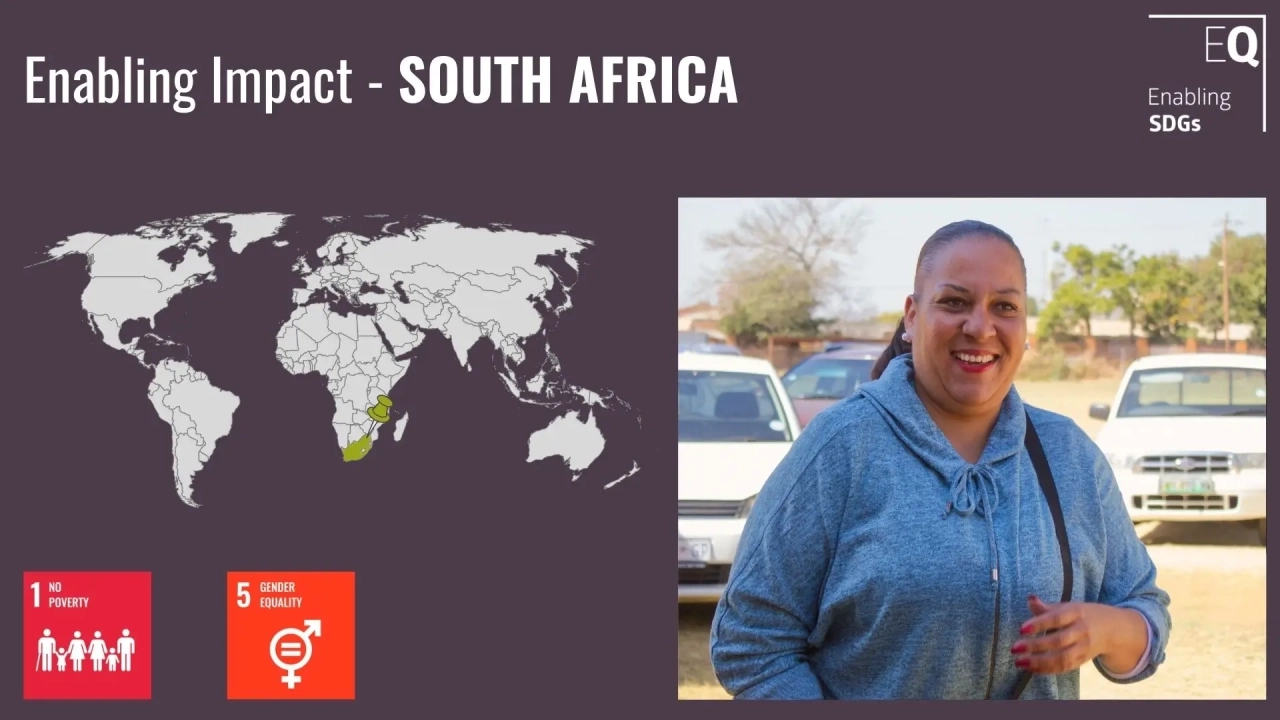
Ms. Pricilia Rammekwa from Thlabane Township is one of the women using SEF loans to stabilise her household. Her first loan of R1,500 (about USD 87) allowed her to repair two rental rooms. She has since expanded to four units and now qualifies for loans of up to R35,000 (about USD 2,000). The rental income gives her family more breathing room and helps cover unexpected costs.
Even though she now qualifies for an individual loan, she chooses to stay in SEF’s group model. The regular meetings, mutual support, and accountability matter to her. This support has strengthened her confidence, improved her planning, and helped her maintain consistent repayments.
Impact at scale
Ms. Rammekwa's experience reflects SEF's broader approach: providing practical tools that help households manage uncertainty and build assets gradually. As of October 2025, the organisation manages a loan portfolio of around R520 million (USD 27.6 million) and serves roughly 117,500 clients across several provinces. Most are women who use SEF’s microloans to support household resilience and small business activities, reflecting SEF’s mission to empower women and reduce poverty at the community level.
Why this matters
Ms. Rammekwa’s experience shows how reliable, human-centred financial services help families plan, cope with shocks, and build stability over time. SEF's model shows that when clients understand their loans and have access to trusted support, the impact extends beyond income to household security, dignity, and long-term stability, helping to narrow the gap in one of the world's most unequal societies.